Regulation, Simplification, and European Values

Europe needs to strike a balance between regulation and simplification. To do so, Europeans need to agree on working together. This is not an easy condition to meet, particularly when it suggests a normalisation of extremist politics. Yet retreating from Europe is not an option. If anything, national politics is even more divided. Learning to find common ground and working together is the only sustainable way forward. Doing so will involve compromises, many of which will be difficult to accept. But there is no better alternative.

Continue reading →

How Long Will the Dollar Remain the World’s Currency?

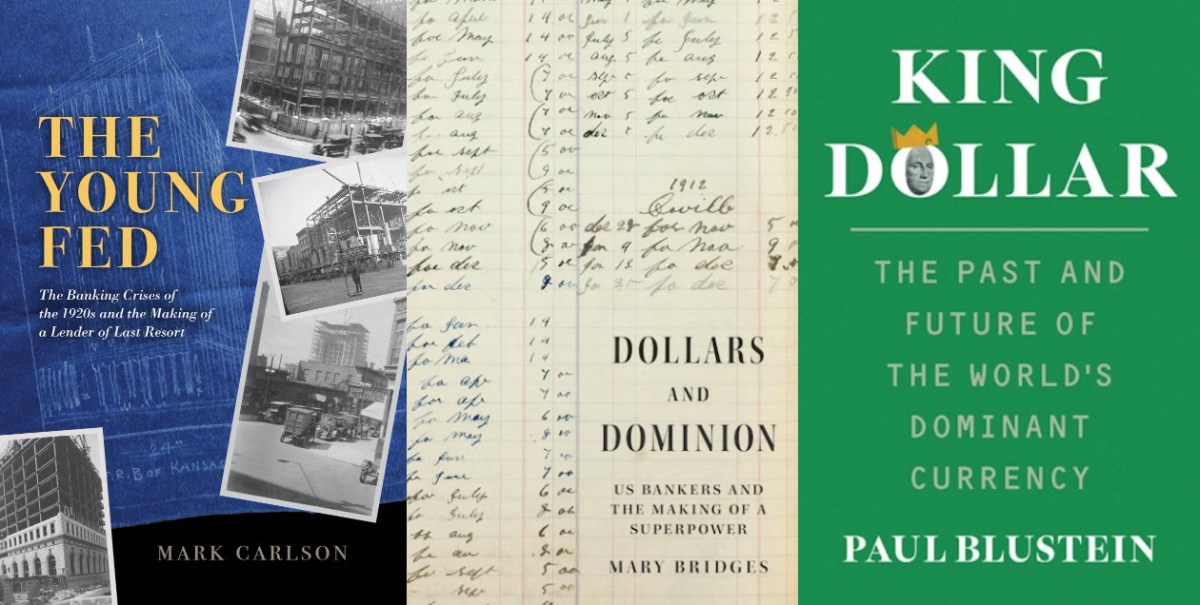
To understand the future of dollar dominance, you need to understand its past.  The recent books about the early experiences of the U.S. Federal Reserve System (Mark Carlson), the spread of U.S. banks abroad (Mary Bridges), and the resilience of the dollar as a global currency (Paul Blustein), offer essential insights for any debate about how either other national currencies or new technologies could replace the dollar in world markets. The dollar’s emergence as a global currency came unexpectedly; its disappearance may be unexpected as well.

Continue reading →

Three Perspectives on Money, Finance, and Central Banking

Last autumn I reviewed three books that highlighted different perspectives on money, finance, and central banking that deserve closer attention. 

In the first book, Gottfried Leibbrandt  and Natasha de Teran point out that the main reason to have money is to make payments – which means that when you start to change the payments system, you wind up changing just about everything connected to money.  That ‘wallet’ on your cell phone is only the tip of the iceberg.

In the second book, Fabio Mattioli explains that when we talk about finance, we are primarily talking about forward looking contracts – and those contracts are only as good as their enforcement.  By implication, a financialized economy looks very different when politicians start deciding which contracts will be honoured and which will not.  Any debate about ‘rule of law’ goes to the heart of the financial economy.

In the third book, Willem Buiter reminds us that the central bank is a public asset owned by the national state. If national governments accounted for that asset in their balance sheets, they would uncover important revenue streams that could stimulate the economy and reduced burdens on taxpayers.  The ‘helicopter money’ that policymakers talked about both during the global economic and financial crisis and at the start of the pandemic is not as strange or uncommon as you might think.

***

Continue reading →
From Narrative to Crisis: The Future of Economic Thought

Three recent books explore important changes in the way we understand the economy. Robert Shiller focuses on the need to bring in ‘narratives’ that circulate within the economy or that can be borrowed from other disciplines; Thomas Philippon asks why America gave up on free markets and looks again the importance of regulation in relation to market competition; and James Gerber examines the influence of financial crises and the lessons we learn in their aftermath. Together these books tell us a lot about where economic thinking is headed. The novel coronavirus pandemic has done little to change the direction of travel and much to accelerate the pace.

Continue reading →

This Is What European Disintegration Looks Like

The European Council decided during a summit organized to address the COVID-19 crisis on 23 April to confirm a European Commission program to support national insurance systems. They also approved a program by the European Investment Bank to support lending to small and medium-sized enterprises, and another by the European Stability Mechanism to make loans available to national governments to pay for health care expenses related to the pandemic. Finally, the Council asked the Commission to set out a roadmap for the creation of a ‘recovery fund, which is needed and urgent’. Supporters of the decision hailed it as an unprecedented leap toward a Europe of solidarity; critics decried it as vague and insignificant. They are both wrong and right at the same time.

Continue reading →

Getting Ready for the 23 April European Council

The European Council will meet by video conference next Thursday.  When it does, the three main items on the agenda will be to approve the recommendations made by the Eurogroup on 9 April, to push forward the conversation about a European Recovery Fund, and to restart and restructure the talks about the upcoming multi-annual financial framework.  In English, that means the conversation will be about money.  Like any conversation about money it will be difficult.  The opportunities for misunderstanding are everywhere.  Now is a good time to sort out some of the issues.

Continue reading →

Why Share Risk through the ECB?

I am an American – an outsider – not a European. I have been studying and living in Europe for a while; I wrote my doctoral dissertation on Dutch politics; I spend more time now looking at politics in Italy. Alongside that political interest, I have spent much of the past thirty years looking at European monetary integration. Europe has taught me a lot, but there are still many things I find confusing. Top of the list right now is that the governments of the euro area would rather accept a higher shared risk in the ECB than they would face if they agreed to share risks through an institution specifically designed to raise credit in the markets. This strange choice about how to share risks matters because the risks the European face have never been greater.

Continue reading →

Paolo Gentiloni: Macroeconomic Governance in the Crosshairs

Paolo Gentiloni began his tenure as European Commissioner today by giving an interview in Corriere della Sera. He spoke about a number of the major issues the new Commission has to face, but the part of the conversation that made the front page ran something like ‘the reform of the European Stability Mechanism is not a threat.’ Flip to page three and the title is even more explicit: ‘There is no plot in Brussels against Italy.’ European macroeconomic policy coordination is politically explosive. Gentiloni is the Commission’s first line of defence.

Continue reading →

Central Bank Independence and the Future of the Euro

Central banks are never independent from politics. The bankers who run those organizations may have the institutional power to define their own objectives, the technical capability to adjust the settings on their monetary instruments, and strong legal protections around the terms and conditions for their employment. But none of that is enough to insulate them from politics. Determined politicians will find a way to exercise influence, no matter what the obstacles. More often than not, such politicians will do so without even implicating the legislative process. They do not have to rewrite the laws to violate central bank independence. Politicians only need to take advantage of the fact that central bankers come from society, they (and their families) have to live somewhere, and eventually they will also retire.

Continue reading →

Modern Dilemmas of Central Banking

Central banks have been in the news a lot lately, with Mario Draghi’s dramatic decision to redeploy the full range of unconventional policies alongside Jerome Powell’s more obvious ambivalence about loosening the monetary spigots. In part this is a function of timing. The business cycle is turning and yet central banks have not quite managed to reset their instruments after the last crisis. Part is also due to overload. Central banks have been ‘the only game in town’ for a long time, they have expanded responsibility for prudential oversight, and politicians seem none too eager to assume responsibility for macroeconomic performance. It would be a mistake, however, to focus too much on short term explanations. Three recent books explore some of the deeper forces that have pushed central bankers into the spotlight.

Continue reading →