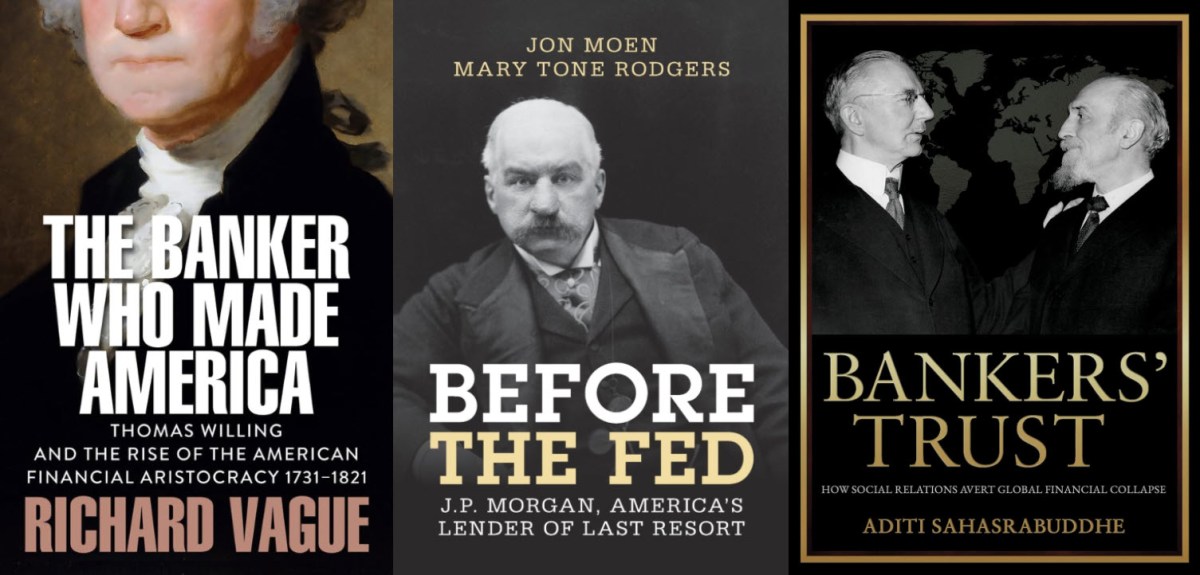
When Europeans complain about the slow pace of progress in building a ‘banking union’, a ‘capital markets union’, or a ‘savings and investment union’, they imply that it was ever easy elsewhere. The reality is that other compound polities like the United Kingdom, the United States, and Canada have struggled with the same issues of providing financial stability and efficient markets for centuries. Geoffrey Underhill and I spent the better part of a decade drawing the comparison in these two essays for The World Economy (2023) and the Journal of European Integration (2024). But you can also see the slow pace of progress in three excellent recent books on American financial history by Richard Vague, Jon Moen and Mary Tone Rodgers, and Aditi Sahasrabuddhe. The story they tell is about how America was only born because Americans were able to create banks, how it almost collapsed without a functioning central bank, and how it still struggles to find the right balance between efficiency and stability. These books are essential reading. The reviews that follow are just a teaser of the insights they bring.
The Banker Who Made America: Thomas Willing and the Rise of the American Financial Aristocracy. By Richard Vague. Cambridge: Polity Press, 2026.
Revolutionary America was different from the United States we know today. There were no banks. States issued currency, even if the currency used consisted of promissory notes and most of the coinage came from abroad – the Spanish dollar being popular. And the wealthiest Americans were merchants who managed the triangular trade between Europe, the colonies, and the West Indies. There are parallels, nonetheless. The richer coastal elites had different politics from the middle and lower classes who worked further inland. Even wealthy farmers were in debt. Property speculation was rampant and volatile. And religion played a large role in political identity. We tend to focus on the conflict with Britain, but class conflict – fuelled by identity politics – was simmering.
Richard Vague uses this backdrop of differences and similarities to tell the story of Thomas Willing: ‘the most powerful figure in early American history that you’ve likely never heard of’ (p. 3). Willing was a merchant who aspired to be a banker, if only the British crown would allow the colonies to charter banks. Willing also invested in property, though not as a speculator. He nurtured social relationships on both sides of the Atlantic, including via marriage. He was a politician and a judge, but also a smuggler – running molasses, tea, and paper to avoid ‘unjust’ British taxes. Willing played an important role in supporting a blockade against Great Britain when the tax burden became unacceptable, but he also voted twice against independence at the Second Continental Congress – which is why his name does not appear on the Declaration of Independence.
Willing, Vague argues, was a man of principle, courage, and conviction, but also humility, moderation, and family commitment. This combination was essential to his – and the Revolution’s – success. Even as Willing was leaning against independence, his merchant partnership with Robert Morris was using its smuggling skills and connections to make sure the colonists had enough saltpetre, gunpower, guns, and cannons to fight the British – often pledging their personal credit to make sure colonial soldiers had equipment. Willing and Morris also worked closely with George Washington and Alexander Hamilton. (Much later, Willing hosted Washington’s retirement dinner).
These efforts were not always popular, particularly at a moment of intense class conflict. John Adams complained that Willing and Morris were war profiteers during the revolution and that Willing was a financial power behind the more conservative elements in the Federalist party after independence. Nevertheless, none would act against Willing, Morris, and their colleagues because they recognised the necessity for finance, not just to win the war but to stabilise the economy during the inevitably tumultuous aftermath. Indeed, in many ways, American democracy was born of financial innovation. Willing’s story extends through the creation of a continental currency – initially tied to the Spanish dollar – the elimination of state currencies, the chartering of a bank to help finance the war, the elaboration of a wider system of state-chartered banks to fuel economic activity after the conflict, and the creation of first ‘Bank of the United States’ as a kind of central bank responsible for financing the government while at the same time stabilising the nascent banking system.
Willing and Morris played prominent roles throughout this period, first as equally committed to the cause, and then as representatives of two different kinds of banker. Morris lost his fortune speculating on property, often dragging his friends into trouble. Meanwhile, Willing, the better of the two at risk management, created his own bank and then went on to lead the Bank of the United States, building great personal wealth while at the same time stabilising government finances and helping to make possible the Louisiana Purchase. In this braiding of self-interest with civic responsibility, Vague argues, ‘Willing’s story invites us to think beyond cynicism’. Vague also reminds us that the divisions we see in American society today ‘are as old as America itself’ (p. 380).
Before the Fed: J.P. Morgan, America’s Lender of Last Resort. By Jon Moen and Mary Tone Rodgers. Cambridge: Cambridge University Press, 2025.
Finance during earlier periods in American history is hard to compare with finance today. But high-speed trading algorithms are not the only source of disruption. Any change in technology related to finance creates new forms of uncertainty. Consider the introduction of credit cards. But so do advances in transport, manufacturing, and natural resource extraction. The start of the 20th Century is a good illustration. That was a period of innovation. It was also a time of frequent financial crises.
Jon Moen and Mary Tone Rodgers argue that understanding crisis response at the start of the 20th Century offers important lessons for today. Different periods of financial turmoil share a common feature: all financial market participants benefit from the stability of the system, but they also benefit from risk and volatility around individual transactions. The problem is two-fold: to prevent free-riding while at the same time policing behaviour that would exacerbate volatility or take on excessive risk. If anything, this problem was greater in the late 19th and early 20th Centuries than now because the United States was at the same time the most dynamic and innovative part of the global economy and the one least served with central institutions to stabilise financial markets or to regulate and police market participants. A failure to renew the Second Bank of the United States in 1837 left the country without a central bank even as both state and federal authorities competed for control over markets and institutions. This not only deprived U.S. banks of a clear lender of last resort but also created important sources of regulatory ambiguity. When crisis struck, this ambiguity made matters worse.
Drawing inspiration from the work of Elinor Ostrom, Moen and Roberts show how financial markets can self-govern under sufficient stress: The solution to recurrent crisis emerged first among market participants. Moen and Rogers cast J.P. Morgan as the protagonist, taking advantage of the richness of archival materials relating to his professional and private activities to document the process of trial and error or learning by doing. Nevertheless, they are careful to underscore the contributions of others before and after the period they highlight across Europe as well as the United States.
The story they tell is how Morgan learned the importance of collective action in responding to the crises of 1837 and 1857 by collaborating with George Peabody and Junius Morgan, J.P.’s father. Morgan also learned to build wide-reaching networks and to rely on subject-specific expertise. In this way, Morgan could pull together groups of market participants to provide liquidity collectively while at the same time calling on support from the U.S. Treasury as well as the central banks of Britain and France. Morgan used financial incentives to bind market participants together, and temporary syndicates to make sure his partners lived up to their commitments. He drew on subject-specific expertise to help in identifying the nature of the crisis and the institutions most in need of assistance. And he brought in the public entities by highlighting the consequences off inaction.
Moens and Rodgers make it clear that this practice started out of self-interest. Morgan and his businesses had much to lose in any crisis. But it continued as Morgan came to appreciate the increasing complexity of financial market dynamics, the unexpected ways that the real and financial economies interact, and the importance of making individual sacrifices in the interests of systemic stability. The narrative culminates in 1907 as Morgan races from one potential disaster to the next, organising syndicates that extend far beyond traditional financial institutions while at the same time juggling political relations in the United States and Europe. Morgan succeeded in orchestrating a successful response but only at great personal expense. The conclusion he drew was that spontaneous self-governance cannot be taken for granted: Financial markets need institutionalised support. The inaugural President of the First Bank of the United States, Thomas Willing, would have sympathised (see previous review). The Federal Reserve Act followed shortly thereafter.
Bankers’ Trust: How Social Relations Avert Global Financial Collapse. By Aditi Sahasrabuddhe. Ithaca: Cornell University Press, 2025.
The Bankers’ Trust was created in 1903 as a privately operated corporation to finance New York banks that got into difficulty. The word ‘Trust’ in the name refers to the corporate governance arrangement used when the organisation was chartered. If founded today, it would more likely be called a ‘holding’, short for holding company. Moreover, at the time ‘Trusts’ were not much ‘trusted’ in American society – and hence the development of anti-trust legislation. Bankers were not much trusted either, particularly when they came from New York. It is ironic, therefore, that New York bankers saved the U.S. economy from the 1907 financial crisis, and that trust among bankers was crucial to that effort. Moreover, the Bankers’ Trust played a critical organisational role under the guidance of J.P. Morgan. Benjamin Strong, a leading Bankers’ Trust official, was at the centre of the fray. What he took away from the experience was the need to combine both ‘trust’ – as an emotional commitment – and institutions. Strong played a leading role in proposing the early design for the Federal Reserve System and in leading the New York Federal Reserve once it was established.
This background is useful to understand Aditi Sahasrabuddhe’s inciteful account of how social relations avert global financial collapse. Her book, Bankers’ Trust is about the social affect and not the historical institution. Sahasrabuddhe argues that even today institutions are insufficient to stabilise international financial markets. We still must rely on specific human agency and the bonds of trust and affinity that lie between them if we are to explain patterns of collective action in response to the threat of financial crisis. Strong’s role as New York Fed chair lies at the foundation of Sahasrabuddhe’s historical narrative. The New York Fed is the external face of the U.S. Federal Reserve System and so has responsibility for managing the relationship between the U.S. dollar and other global currencies. When Strong took up his role at the New York Fed he brought with him an understanding of the need to rely on close personal relations in fostering collective action that he observed working with J.P. Morgan (see previous review). Sahasrabuddhe argues that this sensibility – expressed not just by Strong but also Britain’s Montague Norman – played a crucial role in ensuring the relative stability of the 1920s.
The 1930s were a different period. Changes in leadership, particularly after Strong’s death and Norman’s departure, brought in a new cast of central bankers who lacked strong bonds of mutual affinity. If they failed to respond adequately to the turmoil that grew into the Great Depression, the absence of trust is an important part of the explanation. More important, the institutionalisation of support in the form of the postwar Bretton Woods System was insufficient to make the problem go away. Although tight controls on capital mobility couple for foreign exchange restrictions could create a semblance of stability, that institutionalised solution appeared less resilient once those restrictions were lifted even as policy makers resisted the stigma attached to institutional assistance.
The solution lay in a combination of trust and secrecy. Sahasrabuddhe shows the importance of these elements both when they were absent at the start of the 1960s and when they were present later in the same decade. She also highlights how the Bank for International Settlements emerges as a focal point for socialisation and coordination. And she is able to extend the argument to the global economic and financial crisis, suggesting how the Fed’s approach to creating bilateral swap facilities with other central banks relies heavily on the bonds of trust between the leaders of corresponding institutions. In doing so, Sahasrabuddhe makes an important contribution to recent scholarship that stresses the relational aspect – in a very human sense – of international relations. These bonds of trust are not the only story. Sahasrabuddhe leaves out how direct asset purchases by the Fed pushed dollar-denominated liquidity into the international system, for example. But the importance of trust should not be discounted too easily. Her insight is worth underscoring today.
***
These reviews were edited and published in Survival, alongside reviews of two other books on issues related to the international economy. You can find the (better) published versions here.
‘Economy.’ Survival 68:5 (2026) pp. 177-184.

