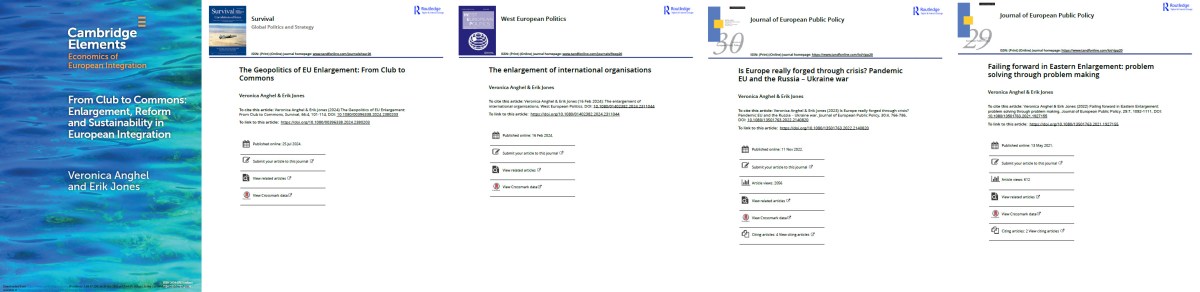
The debate about the future of the European Union (EU) enlargement remains heated, with some voices calling for greater flexibility in response to changing circumstances while others insist on the virtues of a strictly ‘merit-based approach’ to EU enlargement. The question Veronica Anghel and I have been wrestling with is how the changing nature of the European Union interacts with ‘EU enlargement’ as a political process and a policy instrument. We started asking this question before Russia’s full-scale invasion of Ukraine restarted the debate on enlargement in earnest. This collection spotlights the evolution of enlargement in our theory of European integration. It also shows the role of enlargement in European efforts to elevate the role of the EU to that of a geopolitical actor and to achieve ‘strategic autonomy.’
Our main takeaway is that enlargement has always been more flexible than the story about a strictly merit-based approach would suggest. It has also been less successful at ‘transforming’ countries in ways that make them immune to authoritarian politics. These findings are not surprising. If you look closely at the European Union, you will see that each member state has its own take on the European project, each seeks to carve out a special relationship with European institutions and policies, and none is immune from the challenges that liberal democracies face. The European Union can add to democratic resilience, but it also requires that member states exercise self-discipline and that they participate in a game of multilateral surveillance and collective restraint. More important, enlargement takes place alongside changes in the European Union that have a powerful impact on both candidate countries and existing member states.
These findings forced us to engage in a fundamental reconsideration of the European project. This reconsideration rests on a theoretical lens developed by Elinor Ostrom to study how societies face existential crises that arise from the management of common-pool resources like water, wood, fish, or pasture. What we unpacked is a new way to think about how European integration progresses in response to ‘crisis’. That new way of thinking challenges our understanding of how the functions of integration are tied to the operation of European institutions and the relations between member states.
A first culmination of that work is published as a Cambridge ‘element’ (or short book) and is freely available for download under the rules of open access. Caroline de Gruyter published a review of the book in Foreign Policy.
- From Club to Commons: Enlargement, Reform and Sustainability in European Integration. Cambridge: Cambridge University Press, 2025.
What we show in the book is why it makes sense for the EU to engage in institutional reform and enlargement in response to Russia’s full-scale invasion of Ukraine. Those efforts may not succeed in making the EU more secure or more resilient. It is a risky gamble that will require important concessions from all parties. But this is not the first time the EU has made such a bet, and the odds of coming out with a stronger, more secure Europe are much better than with any of the plausible alternatives.
Start with the Big Bang
This insight has been eight years in the making. We started by analysing the historic enlargement of the European Union to the countries of Central and Eastern Europe in the 1990s. The conventional wisdom is that this project was a great success both for the European Union and for the countries that participated in the accession process. We don’t deny that. But we were curious whether that ‘success’ was a reflection of the ambitions of the European Council at the start of the process. Did those European leaders who agreed to expand the European Union at the start of the 1990s and came up with the Copenhagen Criteria for managing that process actually get what they wanted, or was the ‘success’ of EU enlargement disconnected from their original ambitions?
What we discovered is that the actual enlargement of the EU was very different from what those European leaders expected – both because of their reactions to intervening events and because of the influence that political leaders in the candidate countries had on the accession process.
- ‘Failing Forward in Eastern Enlargement: Problem Solving through Problem Making.’ Journal of European Public Policy 29:7 (2022) pp. 1092-1111.
This finding is important because it challenges the myth that enlargement was ever based on ‘merit’ alone. Of course, it is true that candidate countries face considerable obstacles in joining the European Union, and that process has an important transformative effect both on the candidates and on the European project. But the motivations underpinning the accession process are more inconsistent and volatile than the notion of a merit-based approach suggests.
The New Strategic Imperative
Russia’s full-scale invasion of Ukraine took place soon after we published those findings. The European response was to restart the enlargement process by offering a membership prospect to Ukraine, Moldova, and Georgia, while at the same time reactivating the moribund accession talks with the countries of the Western Balkans. This response was in many ways unexpected. None of these countries were any closer to meeting the requirements for membership after Russia’s invasion than they were before. The onset of war did not change that calculus. But it did change Europe in a geopolitical sense. It also changed the way Europeans thing about their collective agency, solidarity, and resilience.
- ‘Is Europe Really Forged through Crisis? Pandemic EU and the Russia-Ukraine War.’ Journal of European Public Policy 30:4 (2023) pp. 766-786.
As we considered that transformation, we were initially sceptical that the EU would enlarge again at an accelerated rate. Like many, we suggested a phased integration. Nevertheless, we accepted the logic behind the security imperative and so tried to imagine how to make this new enlargement a success.
- VA – ‘Wartime EU: Consequences of the Russia-Ukraine War on the Enlargement Process.’ Journal of European Integration 45:3 (2023) pp. 487-501. With Jelena Džankić.
- ‘Broken Promises Diplomacy: The Russia-Ukraine War and the End of Enlargement as We Know It.’ In Jelena Džankić, Simonida Kacarska, and Soeren Keil, eds. A Year Later: War in Ukraine and Western Balkan (Geo)Politics. San Domenico di Fiesole: European University Institute, 2023, pp. 6-14.
- EJ – ‘Enlargement and Institutional Reform: How to Make a Credible Security Commitment.’ In Göran von Sydow, Valentin Kreilinger, and Patricia Wadensjö, eds. Perspectives on Enlargement and Reform of the EU: Fit for 35. Stockholm: Swedish Institute for European Policy Studies (SIEPS), 2025, pp. 12-15.
- VA – ‘EU Enlargement: A Strategic Imperative for Survival.’ In Göran von Sydow, Valentin Kreilinger, and Patricia Wadensjö, eds. Perspectives on Enlargement and Reform of the EU: Fit for 35. Stockholm: Swedish Institute for European Policy Studies (SIEPS), 2025, pp. 33-36.
Reconsidering Merit
The success of a wartime enlargement was unlikely to hang on the strict application of the Copenhagen criteria. To understand why, it is useful to consider what it means to say that the EU should try to avoid admitting another country like ‘Hungary’ – meaning, presumably, one led by a politician like Viktor Orbán. That assertion rests on a misunderstanding. The myth is that Hungary joined the European Union and then Orbán won elections in 2010 and everything changed. The reality is more complicated. Orbán was also prime minister during a crucial phase in Hungary’s accession negotiations. His autocratic ambitions then were no different from what they were later, and his power was growing. The application of the Copenhagen criteria failed to capture that risk.
- ‘What Went Wrong in Hungary.’ Journal of Democracy 35:2 (2024) pp. 52–64.
If anything, Hungary was celebrated as a model candidate country – much like Slovenia and the Czech Republic, and – albeit with some initial hesitation – Poland and Slovakia. Each of these countries has since been led by complicated politicians, even if Orbán is an extreme case. This suggests a fundamental problem with the way we think about the transformative power of the accession process.
As a result, we decided to look again at the lessons from the EU’s historic enlargement to Central and Eastern Europe in that context. What we underscored is how the strategic imperative to address political instability in the late 1990s interacted with the accession process both in terms of European ambitions and in terms of its transformative effects. The question we asked is not whether enlargement was a success in absolute terms, but whether it was better than the alternatives.
- VA – European Parliament Diplomacy and the End of the Cold War: The Integration of Central and Eastern European Countries. Brussels: The European Parliamentary Research Service (2025).
- ‘Three Lessons from the 2004 “Big Bang” Enlargement.’ Politics and Governance 12:8358 (2024).
These lessons have direct implications for Ukraine. If the EU is serious about expanding to that country, European policymakers will need to think carefully about how they structure the process both before and after Ukraine gains membership.
- EJ – ‘Ukraine’s Perilous Path to EU Membership.’ Foreign Affairs (30 May 2024). With Laszlo Bruszt.
From Merit to Geopolitics
The same lessons teach us a lot about the challenges that the European Union will face in undertaking a ‘geopolitical’ enlargement. This is not an argument to avoid that choice. It is an argument to consider the implications alongside the alternatives. That consideration of alternatives builds on work we have done on the transatlantic relationship.
- ‘The Transatlantic Relationship and the Russia-Ukraine War.’ Political Science Quarterly 139:4 (2024) pp. 509-528.
It also rests on an understanding of the role enlargement might play should the transatlantic security guarantee either weaken or, in the worst-case scenario, fall apart.
- ‘The Geopolitics of Enlargement: From Club to Commons.’ Survival 66:4 (2024) pp. 101-114.
Based on these insights, we set out a preliminary theory about the enlargement of international organisations with direct implications for how we think about the European project. That theory has general applications. But it also creates a lens for the reinterpretation of Europe in the Cambridge ‘element’ mentioned at the outset.
- ‘The Enlargement of International Organizations.’ West European Politics 48:1 (2025) pp. 1-28.
Next Steps
Veronica has used that theoretical foundation as an impetus to launch a wider conversation about ‘why enlargement is a strategic necessity’ in a popular series of blog posts hosted by the European Consortium for Political Research. At the same time, her research has shifted to focus on how the European Union aims to become a geopolitical power and how it uses enlargement as one of the tools to achieve that goal.
- VA – ‘Why the EU Is a Geopolitical Power: Wartime Enlargement, Integration, and Reform.’ Journal of European Public Policy 32:12 (2025) pp. 2862-2885.
Meanwhile, I have pivoted to focus on how enlargement fits into debates about Europe’s strategic autonomy. The question is not whether enlargement will strengthen or weaken the European Union in that context. Again, the question is whether there are better alternatives and how to make the best of a challenging situation. The European Union is committed at the institutional level; now European policymakers need to embrace that commitment and help raise awareness of what are the implications for Europe.
- EJ – ‘Europe Resolved: The Drumbeat of Strategic Autonomy.’ Survival 67:5 (2025) pp. 29-44.
- EJ – ‘A Post-Atlantic Europe.’ Survival 68:1 (2026) pp. 25-32.
This work is ongoing. We will be sure to bring together any updates. In the meantime, a copy of this packet with PDFs of the articles cited is available upon request.

