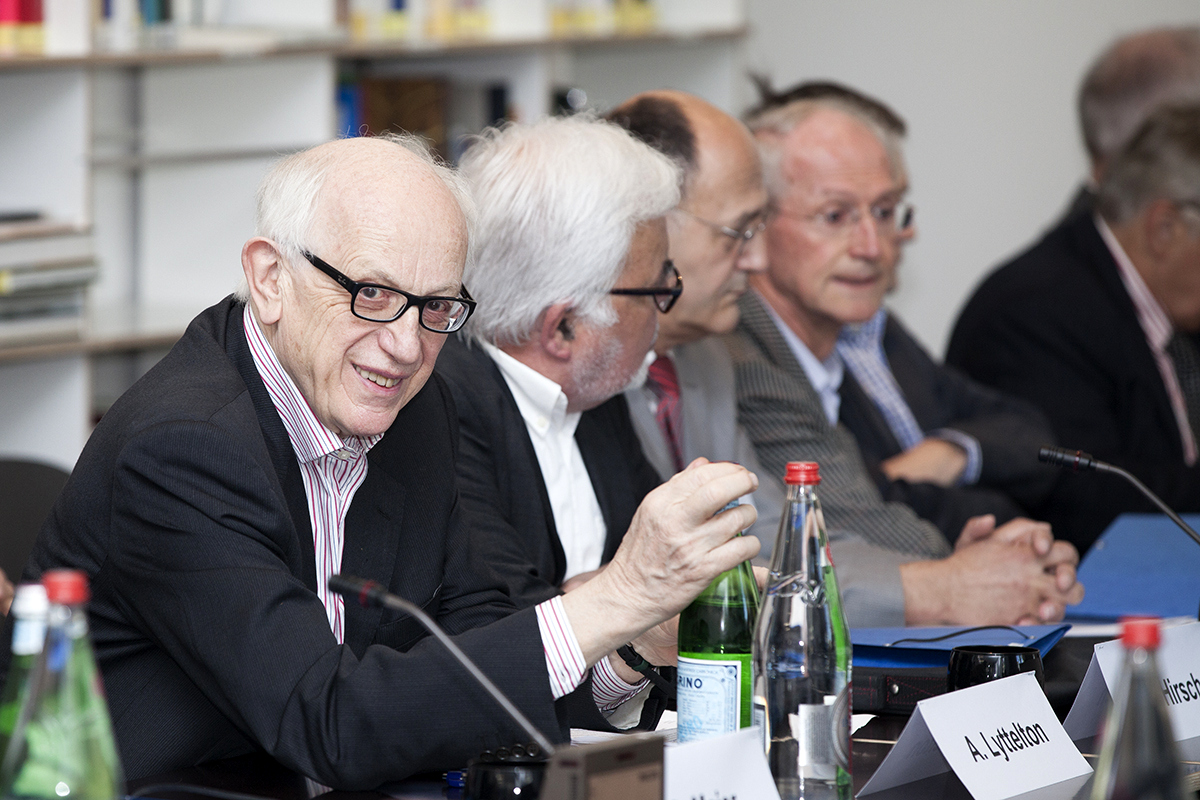
Closing reflections on the life and work of Adrian Lyttleton
Adrian Lyttleton was a beloved professor, colleague, and friend to many of us at SAIS. He passed away last summer. I had the privilege to make these remarks at the end of a celebration held at SAIS in Bologna on 2 October 2026.
What makes Adrian Lyttelton’s legacy so remarkable is that he left the Johns Hopkins Bologna Centre in 1990, thirty-six years ago, and yet his presence remains so strong. How many institutions come together to celebrate a colleague who departed in the middle of his career? And how many former colleagues continue to show the dedication to an institution that Adrian showed long after leaving it?
Adrian never really left SAIS. I once asked him directly why he had decided to leave the Bologna Centre faculty in 1990. He looked at me and said, “They don’t have a pension at Johns Hopkins, but they do at the University of Pisa.” I thought that made perfect sense. If you’re going to leave, you might as well leave for your pension.
But Adrian was always coming back, often with increasingly complicated, sophisticated, and seemingly implausible ideas for seminars. He would propose two days of intense discussion about ideas and politics, and I would wonder how we could possibly persuade students to participate. Adrian would simply insist that we do it anyway. It always worked.
I was impressed by Adrian’s ability to make these things happen, particularly because the subjects he taught were becoming increasingly unfashionable in academic life. He offered sweeping courses in diplomatic history, from the Peace of Westphalia to the end of the Second World War, as well as detailed courses on Italy, at a time when it was becoming increasingly difficult to attract students to such subjects. Yet Adrian taught them effectively and meaningfully.
Adrian’s commitment to that kind of education is something I want to reflect upon. I first came to SAIS in 1988, wanting to study international relations at the end of the Cold War. Two of the first courses I took were Vera Zamagni’s Economics of the Interwar Period and Adrian Lyttelton’s Europe Between the Wars.
Think about that: I arrived to study international relations at the end of the Cold War, and my first semester was devoted to the interwar period. Why? Looking back, I think there are five important lessons in what Adrian (and Vera) taught us, lessons that together constitute an extraordinary intellectual legacy.
Context
The first lesson is about the importance of context. Adrian was a master of context. That was why he was so interested in art, art history, film, and culture. He understood that you cannot understand Italians without understanding what they want, what they appreciate, and what they create. Culture offers a window into a society, but it also helps create that society. These are not separate processes; they are constantly interacting and understanding them requires bringing the different elements together.
To understand the interwar period, therefore, is not simply to tell the history of a particular set of years. It is to understand many different narratives unfolding simultaneously, interacting with one another through complex dynamics. You cannot appreciate those dynamics unless you put context first. Political events, economic developments, cultural movements, and individual motivations must all be understood in relation to one another. That was fundamental to Adrian’s approach to history.
Possibility
The second lesson is possibility. When you embrace context and study history, you are not looking only at the stories history tells. You are also looking at the possibilities it reveals. The one thing you cannot escape is that history involves real people with real motivations, doing things that are often extraordinarily difficult to explain.
The interwar period is a perfect laboratory for exploring this. Imagine Europe, at the height of its civilization, deciding to engage in an orgy of self-destruction. Why did Europeans do that? How could they do that? How could the most advanced economies in the world invest so much in destroying one another?
If you do not accept these as genuine questions, if you do not recognize that such events were possible, then you are missing something essential. They happened. And that is what Adrian taught us: the things that happen must be studied precisely because they can happen. If you fail to bring that sense of possibility into the way you understand the world, you are overlooking something fundamental.
Discipline
The third lesson is discipline. We have endless academic conversations about interdisciplinarity, but they often ignore the fact that there is, in a very important sense, only one discipline. Your arguments must make sense. They must be logical, they must connect to the world around us as we perceive it, and they must tell us something that we can use. That is the discipline.
In conversation with Adrian, this requirement was constantly reinforced. If something you said did not make sense, he would point it out very quickly. It did not matter whether you were an economist, a historian, a musicologist, or an art historian. What you were saying had to make sense. Adrian’s partnerships with Patrick McCarthy and John Harper were very much about this: encouraging us to have conversations in which we could genuinely communicate with one another, across different areas of expertise, through arguments that were coherent and meaningful.
That kind of sensemaking is increasingly rare in the academy today. Perhaps we should worry less about interdisciplinarity and embrace the discipline instead. If we cannot talk to one another, what is the point of all this study?
Questions
The fourth lesson is to ask the right question. I think most people outside academia underestimate just how difficult it is to ask the right question when confronting a complex situation. In the European Studies program, we had a tradition of setting comprehensive examinations. There were three four-hour exams: one on the evolution of the international system, reflecting Adrian’s area of expertise but extending far beyond diplomatic history; another on Europe’s comparative political economies; and a third on Europe’s role in the wider world. We would sit together as a community and debate the questions we wanted to ask the students.
Why did those discussions become so intense? Because if you do not ask the right questions, you will not get the right insights. You will not be able to assess students’ understanding of the material, and you will not be able to learn from the insights they bring to the discussion.
Dana Allin spoke about the democratic nature of conversations with Adrian. I think this is an important part of that quality. If you ask the right question, you can gain insight from anyone willing to engage in the discipline of making sense, to embrace the possibilities of an answer, and to place that answer within the context of lived experience.
These were lessons that Adrian encouraged us to internalize. But it was not Adrian alone. It was a community that included Vera Zamagni, David Calleo, Patrick McCarthy, John Harper, Tom Row, and many others, all dedicated to the same intellectual pursuit.
Answers
That brings me to the fifth lesson. Never accept the first answer. This may be a controversial thing to say, but I do not think it is surprising that Adrian never wrote another book on the scale of The Seizure of Power. He was engaged in a process of constant revisionism, always challenging his own interpretation of the world. In some ways, I am surprised he managed to write that first great book, producing something so definitive. Perhaps that surprised him as well. I suspect this is partly why he eventually grew bored with fascism as a subject.
For Adrian, the intellectual task was never simply to arrive at an answer and then defend it. The task was to continue interrogating that answer, testing its assumptions and reconsidering its implications. If you are not questioning the answers you already have, what are you doing?
Implications
These five lessons – context, possibility, discipline, asking the right questions, and challenging the answers – are deeply connected. And I would ask you to consider what the world looks like when we ignore them. What happens when policymakers act without any awareness of context? When, lacking that context, they fail to recognize the broad universe of possibilities before them? When they stop formulating justifications for their policies that make any sense? When they fail to ask the right questions, or indeed stop questioning altogether?
I think this is an accurate characterization of much policymaking today. We see decisions made without the kind of historical understanding that Adrian taught us to develop. And we can see where that leads. It leads to a world in which the first answer offered to a question is immediately accepted, where we no longer interrogate the truth of the experiences around us, and where we, as educators, risk failing to develop the critical minds that the world so desperately needs.
Resolve
We cannot afford to abandon this kind of historical thinking. We cannot afford to reject the lessons Adrian taught us. It took us a very long time to find someone who could replace Adrian in teaching the evolution of the international system, and we eventually found that person in Tom Row. Without Tom, it is difficult to imagine who could offer that kind of teaching today. But we have to find a way. We have no choice.
For schools like SAIS, and for research institutions like the one I now have the privilege of directing in Florence, it is vital that we take the lessons Adrian taught us and bring them into the present. We must continue to apply them as we look toward the future. Because if we do not, then we deserve the world we live in. And I do not think that is a world any of us would want. I believe we can do better.
But we can only do better if we practice what Adrian taught us and demanded of us in the classroom: understand the context, recognize the possibilities, make sense of our arguments, ask the right questions, and never stop questioning the answers.

