The Aspen Institute Italia held its first-ever US-Italy dialog in Rome on 3 December 2018. As part of that conversation, the director of Aspenia, Marta Dassù, asked me to make a few remarks on global trade. Here are five quick thoughts.
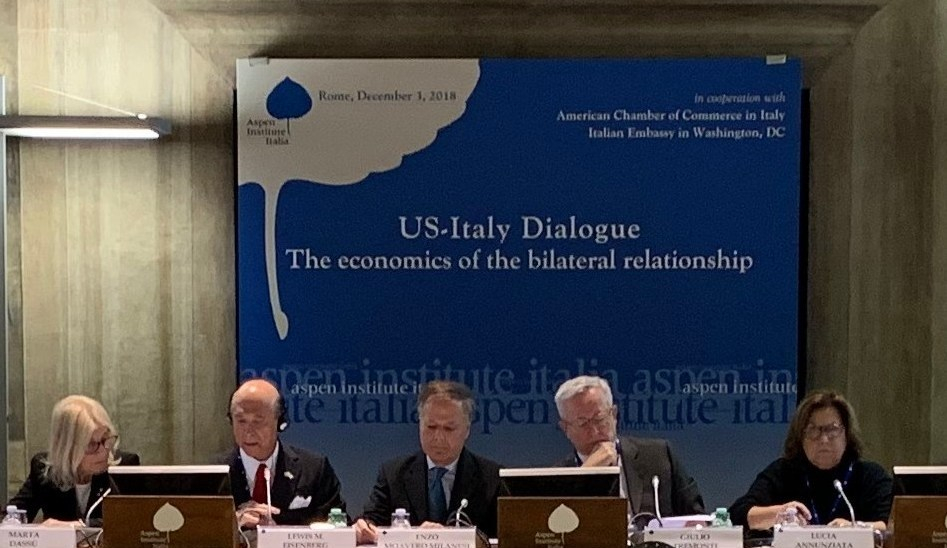
The Aspen Institute Italia held its first-ever US-Italy dialog in Rome on 3 December 2018. As part of that conversation, the director of Aspenia, Marta Dassù, asked me to make a few remarks on global trade. Here are five quick thoughts.

On 28 September 2018, Lorenzo Forni of Prometeia invited me to give a short comment on the relationship between ‘populism’ and economic policy-making. Although, I hadn’t thought about that relationship before, I came up with four things I think we might want to consider (in addition to what we might useful think of as ‘populism’ in the context of the question Lorenzo asked). My argument was that populists bring new people into the policy-making process. They also bring a healthy dose of unpredictability. Their messaging on policy issues is not great, which causes problems in a world defined by rational expectations, and they tend to be skeptical toward independent agencies like central banks. Finally, populists are disinclined to international policy coordination. The combination is not wholly bad — sometimes change is for the good! — but the results are often below the promises that populists make to the electorate. The text of the presentation follows.

On Tuesday, 6 November, Americans went to the polls to elect members of the House of Representatives, one-third of the membership of the Senate, a handful of state governors, a host of politicians at the state and local level, and a series of ballot propositions concerning local rules and finances (like bond issues for school maintenance) across the country. These elections are called mid-term because they are held midway through the four-year term of office of the sitting national president.
The name ‘midterm’ is misleading, however, because it makes these elections sound like a national contest. They are not. Although the election results will have a strong impact on the performance of the national government, the mid-term elections are primarily local contests. Moreover, despite and perhaps even because of the very prominent role played by President Donald Trump in the campaign, these mid-term elections were even more local than most.

Steve Bannon is coming to Brussels to repeat the success he had during the Trump campaign in the upcoming elections to the European Parliament. He has held high profile encounters with Matteo Salvini, Marine Le Pen, and even Boris Johnson. He has talked to the press, toured the capitals, and now set up his own office, called ‘The Movement’. As he has done all this, Bannon has raised awareness that there are a lot of people in many different European countries who are fearful about migration and fed up with their ruling elites. On the surface, that picture does look a little like the discontent Bannon tapped in the United States. But if Bannon is hoping to use the same arguments and tactics, what will matter more is how Europe is different.

As the Trump Administration prepares for the G7 meeting in Canada, the bulk of commentary in the press is focusing on how isolated the United States has become. The aluminium and steel tariffs, the renegotiation of the North Atlantic Free Trade Agreement (NAFTA), the withdrawal from the joint comprehensive plan of action (JCPOA) with respect to Iran, and the repudiation of the Paris accords all combine to create tension between the Trump Administration and its G7 partners. At the same time, the Trump Administration seems more interested in courting China, Russia, and North Korea than its traditional allies. Hence the question is not just what the Trump Administration hopes to achieve but also why it is bothering to attend at all. The answer is revealing both for what it says about the Trump Administration’s approach to global governance and what it reveals about the enduring legacies of U.S. leadership during the post-Second World War era.

The fast pace of change in Italian politics has left many observers outside the country struggling to catch up. This collection offers a quick overview in bullet points with links to recent articles I have written in case you have interest in learning more. I am going to list the material in reverse chronological order. Most people want to know what is happening and then figure out why. If you are one of those people who works the other way around, I advise you to follow the links from the bottom up.

Steve Bannon came to Italy and was greeted with a full-page interview this Sunday (3 June) in the center-left daily newspaper, La Repubblica. The journalist, Antonello Guerrera, seemed determined to find Bannon’s influence behind the unlikely union of Matteo Salvini’s Lega and Luigi Di Maio’s Five Star Movement (M5S). Bannon would have none of it. Although he admitted to having spoken with both gentlemen and having had prior contact with the M5S, he insisted that the two groups came together because sharing the government between them was ‘the logical conclusion’. The two parties’ leaders were ‘heroes’ for having ‘overcome the concepts of left and right’. That was the only way to meet the demands of an electorate, the majority of which voted ‘against the establishment’. ‘Italians should be proud.’ Now Rome is ‘the center of world politics’. The question now is whether the lessons from Italy’s experience are at all in line with what Bannon expects.

Yesterday I had the opportunity to have an exchange of emails with one of Italy’s leading financial journalists. This is part of a longer conversation we have been having over the past few years about the state of European financial markets and the role of Italy within them. The difference this time is that he published the exchange in gli Stati Generali, which is a project created to allow journalists to share stories or rely on formats that might not otherwise find their way into traditional media outlets. Knowing the journalist, the Italian version of our exchange is much more articulate than the English-language original I am reproducing here. The questions are in bold; my responses are in regular text.

Donald Trump is torn between two ambitions. One is to challenge the conventions that have underpinned U.S. foreign policy by replacing a commitment to global leadership with a determination to put America first. The other is to undo the legacy of Barack Obama. Neither ambition is easy to accomplish; taken together, the two ambitions constitute an enormous task. Sometimes they overlap. Sometimes they point in different directions. And sometimes they interact in a dizzying manner. Trump’s policy toward Asia is of the dizzying sort. Where Barack Obama pivoted to Asia from the Middle in a manner that both confirmed and defied U.S. foreign policy convention, Trump seems to twirl around Asia in an accelerating pirouette.

The voting in Catalonia was a trap for Spain’s political leadership in Madrid. They were going to be criticized if they ignored the vote and also if they tried to stop it. Moreover, shunting responsibility for dealing with the crisis on the courts and the police as institutions was no way out. Ultimately, institutions are about people and not just words on a piece of paper. The voters in Catalonia know that. Now the Spanish government will be held to account. Political leaders everywhere should pay attention.
 Erik Jones