
The President of the European Commission hosted an event to mark the one-year anniversary of the report on European competitiveness drafted by former Italian Prime Minister and European Central Bank President Mario Draghi last September. The message coming out of that meeting both from the European Commission President and from Draghi was that European policymakers need to do their homework. Too many items from the Draghi agenda remain unimplemented or only partly addressed. Too much more needs to be accomplished. And time is of the essence. The world is only becoming more volatile, more uncertain, and more dangerous. Europeans cannot afford to wait in preparing for this changed geopolitical environment, otherwise they will suffer the consequences. ‘Europe’ may even fail as a political project.
Such dire warnings are important to encourage action. The European Union (EU) will only succeed – prosper, promote its values, protect its interests, hang together, and stabilise its neighbourhood – if European policy makers accept the need for reform and coordination, and explain that need to the wider public. Nevertheless, it is important for the incoming Cypriot Presidency of the Council of the European Union not to let this call to action obscure the scale and scope of the transformation already underway. European policymakers have already made and implemented decisions that will change the EU fundamentally over the coming years and decades. They have done so against a background of geopolitical influences that are equally transformative, and not just for Europe but for every country, region, and international organization. The choice Europeans face is not between change and stability; it is – to borrow from Walter Lippmann’s writing about the United States in the early 20th Century – a choice between ‘drift and mastery’.
The choice for mastery was set out in three linked reports, by former Italian Prime Minister Enrico Letta, Mario Draghi, and former Finnish President Sauli Niinistö. The recommendations in those reports are at the same time reactive and proactive. The reaction is to Europe’s vulnerabilities. The EU lacks secure access to critical raw materials, it lacks self-sufficiency in terms of energy and food, and it relies on complex supply chains to provide essential intermediates for manufacturing. That is at least partly why the EU has engaged in an ambitious enlargement project, why it is has invested so much in the stabilization of its immediate neighbours, and why it has launched an ambitious programme to strengthen partnerships with allies in other parts of the world. Such initiatives not only widen and deepen Europe’s internal market, but they also strengthen European competitiveness and resilience.
The EU also lacks control over global market infrastructures and foundational technologies and standards. This explains why the EU has refocused its attention on strengthening the investment of European savings into European innovation, why it has launched a drive for the simplification of European regulations, why it has created new incentives for investment into European manufacturing, and why it has opened these incentives to partners beyond the EU in exchange for greater commitment to coordination in the interests of mutual benefit. These initiatives have already rewritten the assumptions underpinning European competition and procurement policy. They have also opened new space for the coordinated use of instruments for trade and industrial policy. And they have laid the foundations for Europe – meaning both the EU and its close allies – to assume greater autonomy in the production and supply of defence and dual-use equipment.
More fundamentally, the EU lacks control over the structure of its interdependence. This lack of control was a fundamental choice Europeans made first in embracing the transatlantic partnership and then in promoting a market-centred and rules-based international economy. Now the EU is moving to exercise greater and more deliberate influence over the structure of its relationships with the outside world. It is intentionally redirecting activity away from partners who threaten to use their economic relations with Europe to manipulate European polities or threaten European security. At the same time, the EU is focusing on the development of new instruments to prioritize interdependence on the basis of trust rather than specifically market-based characteristics like absolute or comparative advantage.
These reactive measures come together in the reimagination of the role of the European Union as a source of peace and stability against external threats rather than internal (or historical) animosities. The proactive part of the new European agenda reflects the ability of Europeans and their policymakers to take control of their own future. This new EU will necessarily have to assert itself more fully in interactions with other great powers or organisations.
That positive agenda is a feature not a bug. The EU has no choice but to be more assertive if it is to secure European interests. Moreover, European policymakers are aware of that fact. The sense of ‘strategic responsibility’ lies at the heart of the new agenda. The point to underscore is that the change is not only already underway but also irreversible. Many of the most important decisions have been taken and implemented both in Europe and – crucially – in other parts of the world. The old environment when the European Union could rely on effective multilateralism in the context of a rules-based international system no longer exists.
The incoming Cypriot Presidency – and European policymakers more generally – face the unenviable task in explaining that harsh reality to an electorate that is more concerned with the cost of living, the prospects for employment, the consequences of migration, and the provision of health and providential care than geopolitics. Within that context, geopolitics is a source of uncertainty if not concern. The challenge for the incoming Cypriot Presidency is to help European policymakers to provide reassurance as well as encouragement. There is still much for the EU to accomplish in fulfilling the new European agenda, but Europe’s political leaders have already taken the crucial first steps. They know what they need to accomplish. And they have the courage to complete the task.
***
This essay was prepared as part of the recommendations from the members of the TEPSA network to the Cypriot Presidency, which were presented at the TEPSA pre-presidency conference in Nicosia on 30 and 31 October 2025. Many thanks to Nicoletta Pirozzi and Richard Youngs for bringing those recommendations together, and to Allegra Wirmer for preparing the final publication. The published version can be downloaded here.
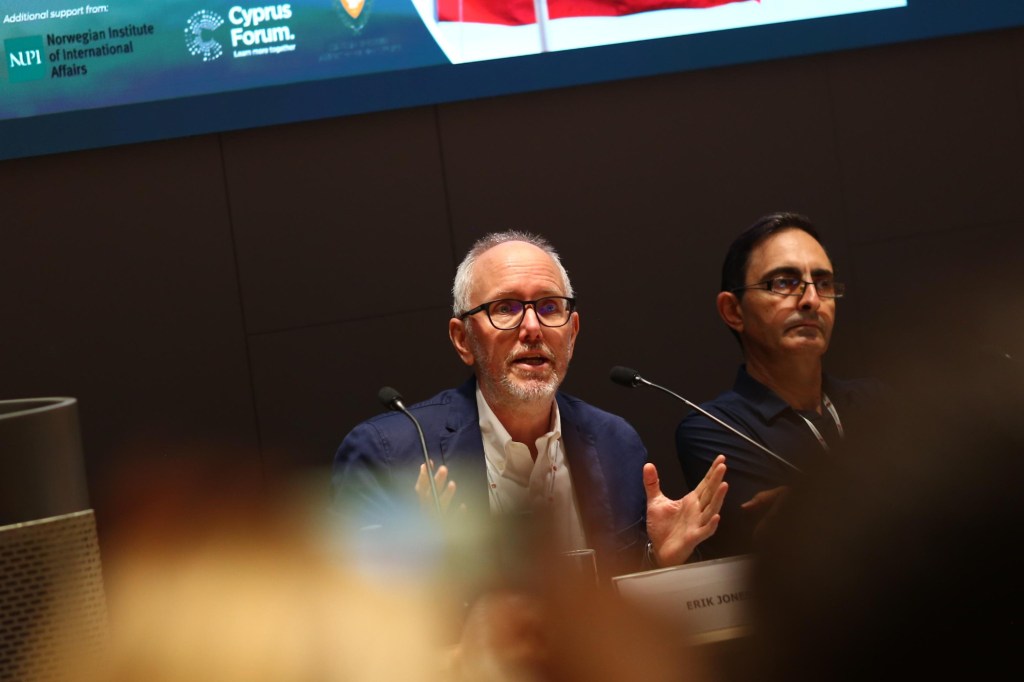
 Erik Jones