Rethinking Europe in an Age of Uncertainty: From Club to Commons

If water started disappearing from the European continent, glaciers melted, rivers ran dry, rain stopped falling, you would think Europeans would come together to do something about it.  They would look closely and compare notes about the sources and uses of water.  They would study why the supply was running down and they would find ways to restrict demand to match.  This would not be an easy task.  It was not an easy task for the communities of the ancient world that lived between the Tigris and the Euphrates either.  Humankind has learned to adapt to these sorts of challenges through bitter experience.  Europeans might fail to pull together, and Europe might be overtaken by the desert.  But they would try very hard to find a solution before they let that happen, and they would work with whomever is necessary to ensure their success.

Continue reading →

The European Union as an Innovation in Politics

People look at the European Union and complain that it is not like a nation state. The EU is slow-moving, indecisive, and lacking in conviction. Look at the weakness of the EU’s response to the atrocities in Gaza, its ineffectiveness in standing up to the United States, and its inability to replace American support for Ukraine. Even the EU’s commitment to climate action appears to be wavering.

Such complaints ignore that the EU is not like a nation state for good reason. The European project exists to temper the behaviour of nation states. It is designed to smooth over the contradictions in liberal democracy and, in doing so, make those democracies both more resilient and more legitimate. And the EU is unique. Only Europeans benefit from that political innovation. The United States does not. Neither does Brazil, Russia, India, China, or South Africa.

Continue reading →

Nationalism, Cosmopolitanism, and the European Project

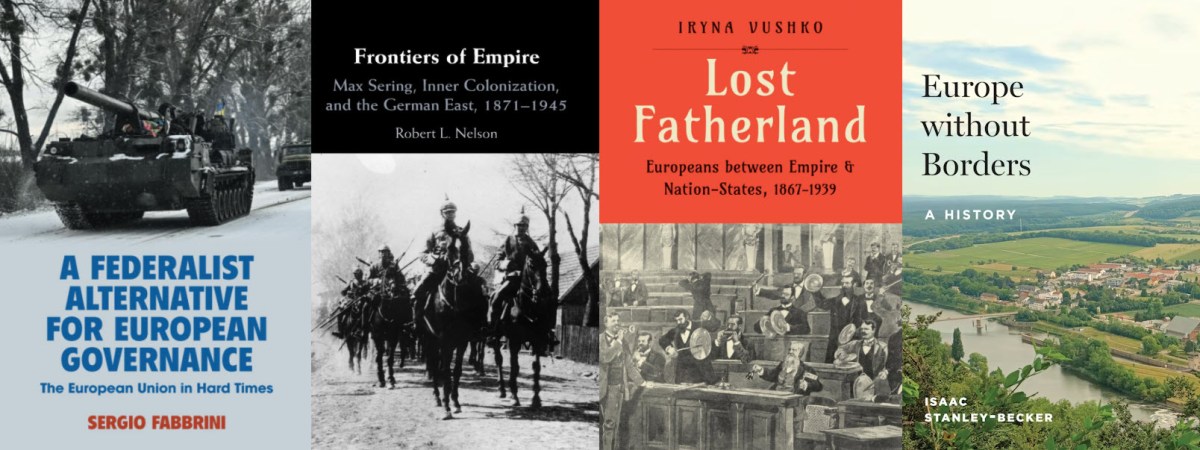
Four recent books – by Sergio Fabbrini, Robert L. Nelson, Iryna Vushko, and Isaac Stanley-Becker – challenge any presumptions about the uniqueness of recent European experience.  They also force us to reflect on how the integration of Europe connects with the integration of individual countries (Fabbrini), how the experience of colonization has shaped the European continent (Nelson), how lessons from Europe’s imperial past continue to influence visions of its future (Vushko), and how the effort to promote freedom of movement has revealed a tension between nationalism and cosmopolitanism that runs across the European project (Stanley-Becker).

Continue reading →

Transatlantic Crisis? Why This Time is Different

To appreciate the radical changes that have taken place in the transatlantic relationship, it helps to have a sense of perspective.  Why is the ‘crisis’ so much more real now than it was in decades past?  You don’t need to do a lot of reading to learn that the relationship has never been easy.  Somehow, this time feels different.  To explain why, I pulled together a collection of thirteen articles I wrote about the evolution of the transatlantic relationship over the past twenty years.  One of the articles was published in Italian and so I included the English-language working paper for those who are interested.  There are three big themes in this collection – about the changing nature of power in international relations, the challenge of maintaining domestic support for engagement with the outside world, and the progressive loss of trust across the Atlantic together with the breakdown of solidarity on either side.  The articles in this collection were not written to trace these themes.  Those themes arose as I kept coming back to the same subject matter from one year, election, administration, ‘crisis’, or decade to the next.

Continue reading →