Donald Trump’s assault on the political independence of the U.S. Federal Reserve has been brewing for a long time. And his attack on central bank independence is also not limited to the United States. Governments in other countries have been at it for a while now. The reason is simple. The ‘Great Moderation’ achieved by monetary economists in the 1990s and early 2000s proved unsustainable. The ensuing crisis made it easy for politicians to challenge central bank independence.
There is nothing surprising about the failure of central bankers to avert the crisis. When the world changes, economic ideas need to change as well. Nevertheless, in the trial-and-error struggle to adapt to the new situation, monetary policymakers had to pay attention to financial stability as well as price inflation. And once they gave priority to financial stability, they began to intrude on questions related to who wins and who loses in an immediate sense as well as over the longer term.
Those questions about who wins and who loses are not easy for politicians to leave to technocrats. Hence the challenge to central bank independence was widely anticipated – even by the central bankers themselves. The problem is that politicians aren’t any better at managing monetary policy now than they were during the time of the ‘Great Moderation’. Donald Trump may want to assert control over the Fed – and politicians elsewhere may try to follow his example – but this is unlikely to result in better monetary policymaking. If anything, the policy environment is more complicated.
Argument
The purpose of this collection is two-fold:
First, I want to sketch why monetary policymaking became so politically controversial both during the crisis and in the years that followed. This is not so much a story about understanding global economic dynamics, as it is a story about the political consequences of using unconventional monetary policy instruments (or unconventional settings on conventional policy instruments).
Second, I want to show how monetary policymaking has evolved in the European Union from the end of the acute crisis when European Central Bank (ECB) President Mario Draghi promised to do ‘whatever it takes’ to safeguard the euro through the ECB’s response to the burst of inflation that followed the pandemic. This is a story about the emergence of a new framework for monetary policymaking that European central bankers are only just now bringing about.
By telling these two stories together, I want to suggest how the failure to understand the dynamics underlying a globalised world economy at the turn of the 21st Century contributes to the problem of global fragmentation that we are experiencing today.
Prologue
The collection starts by focusing on how the ECB responded to the onset of the global economic and financial crisis, how that response reflected confusion over what were the underlying dynamics in global macroeconomic performance, and how that response also created confusion in popular perceptions of monetary policymaking. This cluster of articles both informed and draws on a set of weekly essays I wrote during the period that ran from the run-up to Draghi’s ‘whatever it takes’ speech in July 2012 through the bailout of Cyprus in March 2013 and its immediate aftermath – called The Year the European Crisis Ended (London: Palgrave, 2014). It concludes with an essay about what we should learn from the crisis.
- ‘Output Legitimacy and the Global Financial Crisis: Perceptions Matter.’ Journal of Common Market Studies 47:5 (2009) pp. 1085-1105.
- ‘The Euro and the Financial Crisis.’ Survival 51:2 (2009) pp. 41-54.
- ‘Reconsidering the Role of Ideas in Times of Crisis.’ In Leila Simona Talani, ed. The Global Crash: Towards a New Global Financial Regime? London: Palgrave, 2010, pp. 52-72.
- ‘Getting the Story Right: How You Should Choose Between Different Interpretations of the European Crisis (and Why You Should Care).’ Journal of European Integration 37:7 (2015) pp. 817-832.
Of course, European policymakers still had a number of awkward moments after the bailout of Cyprus. The Greek crisis in 2015 was probably the darkest part of that experience. But that is more a story about European monetary integration than a story about monetary policymaking – even though we are talking about the period when the ECB engaged in some of its most ambitious experiments with negative deposit rates and large-scale asset purchases. I have another collection to cover that narrative and you will find a summary in the long essay on the politics of economic and monetary union below.
Attempting Normalisation
The monetary policymaking story in this collection starts once the acute phase of the crisis has passed and the focus turns to efforts to unwind the crisis instruments (or instrument settings) that had been deployed earlier. Fortunately for the ECB, U.S. monetary policymakers were the first to move toward ‘normalisation’. They learned the hard way how challenging it would be to get back to an approximation of the status quo ante – if, indeed, that could ever happen.
- ‘Now for the Tricky Part: Unwinding the European Central Bank’s Unconventional Monetary Policy Stance.’ SEFO – Spanish Economic and Financial Outlook 6:3 (2017) pp. 7-17.
- ‘Forward Guidance and Price Stability: The European Central Bank Seeks to Chart a Clearer Path.’ SEFO – Spanish Economic and Financial Outlook 8:1 (2019) pp. 75-81.
- ‘Three Debates over Monetary Policy.’ SEFO – Spanish Economic and Financial Outlook 8:5 (2019) pp. 5-12.
Even with the U.S. example, however, the ECB struggled. The publications in this cluster run from the first efforts at unwinding the ECB’s balance sheet in 2017 to Draghi’s decision to add more stimulus in September 2019. Perhaps Draghi’s hope was that such action would create the policy space so that his successor, Christine Lagarde, could have more luck a second time around.
Political Consequences
That 2019 decision to add more stimulus exploded the European debate about central bank independence. Although Draghi was probably right that European macroeconomic performance needed more support, his policy actions at the end of his mandate attracted the kind of attention to the ECB that would make the start of Lagarde’s tenure in office more challenging politically rather than easier. This part of the collection explains why that is so both in the European context and within the wider debates about the virtues of central bank independence.
- ‘Christine Lagarde’s Hardest Task Isn’t in Her Job Description.’ Foreign Affairs (5 November 2019).
- ‘Do Central Bankers Dream of Political Union? From Epistemic Community to Common Identity.’ Comparative European Politics 17:4 (2019) pp. 530-547.
- ‘Beyond Central Bank Independence: Rethinking Technocratic Legitimacy in Monetary Affairs.’ Journal of Democracy 30:2 (2019) pp. 127-141. With Matthias Matthijs.
- ‘The Politics of Economic and Monetary Union.’ In Fabian Ambtenbrink and Christoph Herman, eds. The EU Law of Economic and Monetary Union. Oxford: Oxford University Press, 2020 pp. 53-96.
The point to underscore is that monetary policymakers never wanted to be in this situation. In many ways, they felt they had been abandoned by policymakers who controlled other instruments. This was particularly true in Europe, where fiscal policymaking takes place primarily at the national level while monetary policymaking is European insofar as the ECB sets the direction even for those countries that are not part of the single currency.
Try Again
Lagarde understood the political challenge she faced. I am not sure, however, that she was able to connect that challenge to the underlying politics and economics of monetary policymaking – at least not initially. That scepticism comes both from Lagarde’s early efforts at ‘greening’ the ECB and from her initial response to the COVID-19 pandemic. Nevertheless, I think it was important to bring in some fresh ideas, and I also think Lagarde was right to stress efforts to improve central bank communications.
- ‘The Greening of the ECB.’ SEFO – Spanish Economic and Financial Outlook 9:1 (2020) pp. 35-42.
- ‘COVID-19 and the EU Economy: Try Again, Fail Better.’ Survival 62:4 (2020) pp. 81-100.
- ‘Why We Need More Diverse Central Bankers.’ Survival 62:6 (2020/2021) pp. 113-121.
- ‘The ECB’s New Look.’ SEFO – Spanish Economic and Financial Outlook 10:5 (2021) pp. 15-23.
The ECB’s response to the pandemic doubled down on the stimulus that Draghi added at the end of his term. In doing so, it dramatically increased the challenge of normalising monetary policy once the pandemic passed.
The Russia Shock
Then Russia launched its full-scale invasion of Ukraine and the situation only got more complicated. Monetary policymakers had to decide whether the acceleration of inflation they were witnessing was the result of a sudden shock or something that would be more lasting. As in 2017, they also had to consider the danger that any effort to tighten their policy instruments might make matters worse rather than better. These concerns raised fundamental questions about the conduct of monetary policy. They also restarted the debate over the political independence of monetary policymaking.
- ‘The War in Ukraine and the European Central Bank.’ Survival 64:4 (2022) pp. 111-119.
- ‘The ECB’s Policy Conundrum.’ SEFO – Spanish Economic and Financial Outlook 11:4 (2022) pp. 47-54.
- ‘Managing the Risks of Quantitative Tightening in the Euro Area.’ SEFO – Spanish Economic and Financial Outlook 12:1 (2023) pp. 5-13.
My sense is that the ECB did a pretty good job stabilising price inflation in the euro area while at the same time starting efforts to normalise monetary policymaking. What they accepted along the way is that this normalisation would require the creation of a new monetary policy framework. That new framework remains a work in progress, but we are starting to see what it will look like in broad terms. We can also get a clearer sense of what the new ‘normal’ will look like as the world economy moves away from the extensive globalisation that existed at this start of these two narratives immediately prior to the global economic and financial crisis and toward a different, more fragmented arrangement.
The New Normal
Within that new normal, the debate about central bank independence continues to rage. I doubt we will ever see a return to a consensus around central bank independence as strong as the one that existed during the ‘Great Moderation’. My only hope is that the politicians who seek to exercise greater influence over monetary policymaking will take the time to appreciate just how complicated that area of policy has become.
- ‘Rewiring the European Central Bank.’ SEFO – Spanish Economic and Financial Outlook 13:5 (2024) pp. 31-38.
- ‘The ECB’s Next Challenge: Monetary Policymaking in an Age of Uncertainty.’ SEFO – Spanish Economic and Financial Outlook 14:4 (2025) pp. 5-11.
- Lucia Quaglia, et al. ‘The European Central Bank in the International Political Economy (Forum).’ International Studies Review 27:1 (2025) pp. 1-28. My contribution is called ‘Confronting the Democratic Legitimacy of Crisis Policymaking at the European Central Bank’.
There is probably more chance that European politicians will appreciate their limitations in understanding how monetary policy is made than there is that the Trump administration will show the same level of self-awareness. This contrast is important because the way monetary policy is made in the United States is going to have an important impact on Europe.
We tend focus the debate on political independence in terms of democratic legitimation in the domestic context without considering how monetary policymakers need to work across currencies or political jurisdictions to stabilise macroeconomic performance. Recognition of this interaction is important because greater political control over monetary policymaking will reinforce the fragmentation of the global economy. That fragmentation is the focus for a different collection.
***
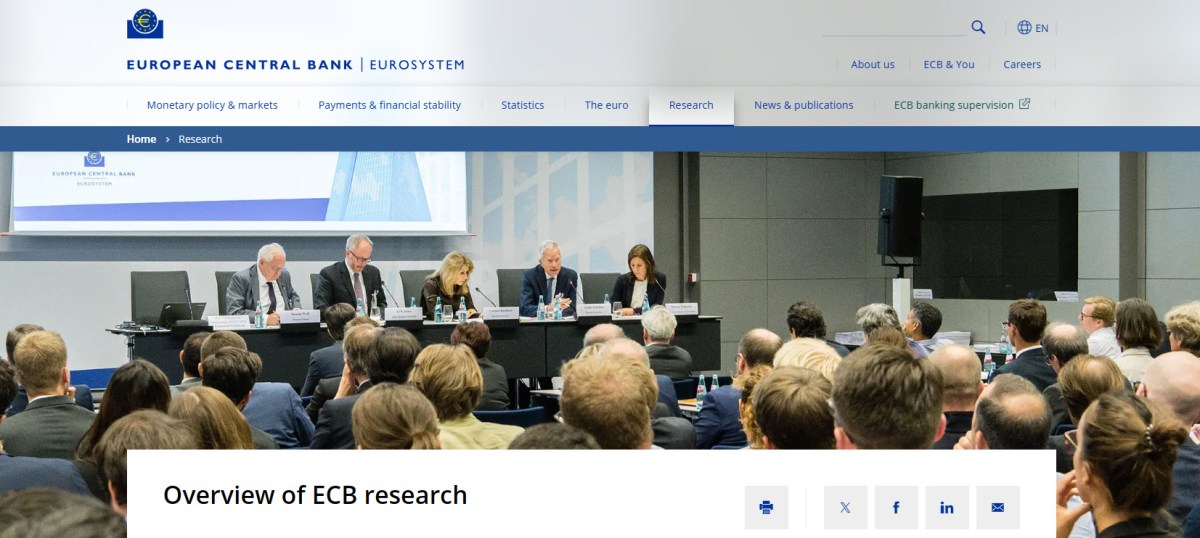
A copy of this collection with PDF versions of the articles listed is available upon request. The cover picture is from the ECB’s website. I made a screen grab before they update it and my experience sharing the podium with such great colleagues vanishes into the digital archive of the internet. If my head is bowed for the photo, it is because I am praying that don’t update the website anytime soon.
 Erik Jones