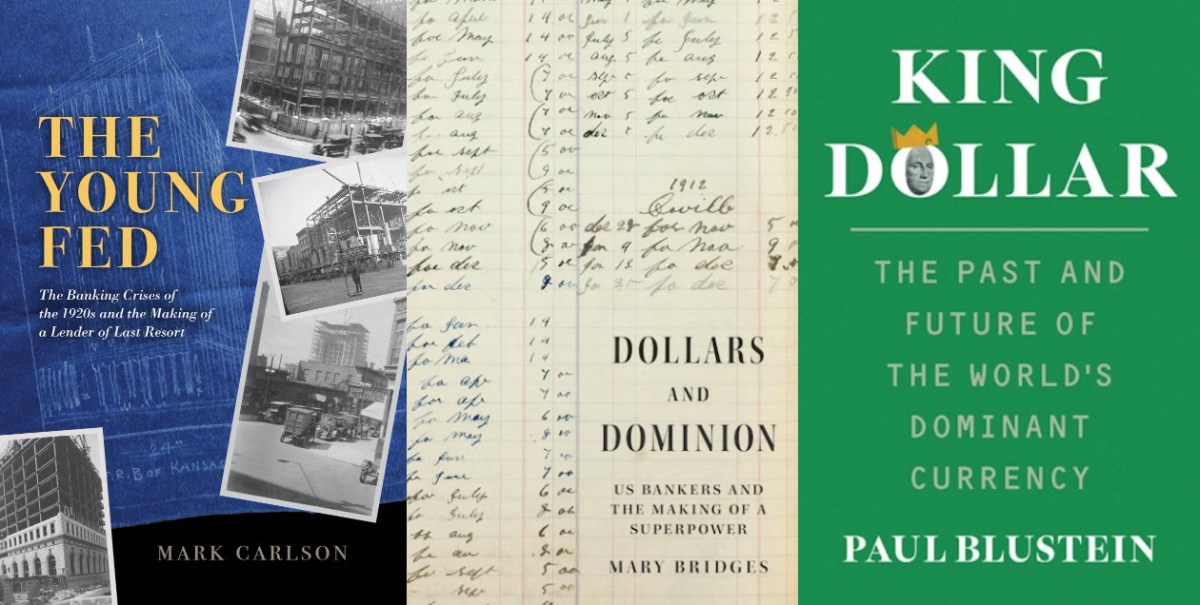
To understand the future of dollar dominance, you need to understand its past. The recent books about the early experiences of the U.S. Federal Reserve System (Mark Carlson), the spread of U.S. banks abroad (Mary Bridges), and the resilience of the dollar as a global currency (Paul Blustein), offer essential insights for any debate about how either other national currencies or new technologies could replace the dollar in world markets. The dollar’s emergence as a global currency came unexpectedly; its disappearance may be unexpected as well.
***
The Young Fed: The Banking Crises of the 1920s and the Making of a Lender of Last Resort. By Mark Carlson. Chicago: University of Chicago Press, 2025.
The United States (U.S.) Federal Reserve System was created after the 1907 financial crisis because the most powerful American bankers realized they needed some way to prevent the many diverse financial institutions scattered across the country from collapsing in successive waves of financial contagion and bringing the big banks down along with them. The system includes twelve Federal Reserve Banks, each of which is responsible for safeguarding financial stability in different national districts, that coordinate at the national level through a board of governors and a chair. Looking back, this whole arrangement seems obvious. The Fed is what it is. Looking ahead from 1913, it is easy to imagine the newly appointed Federal Reserve Bank governors wondering: what next?
Mark Carlson’s story of the ‘Young Fed’ takes place before the Great Depression or the creation of the Federal Deposit Insurance Corporation and at a time when primary responsibility for financial supervision rested either with state bank regulators or the federal Comptroller of the Currency. In many ways, this world is a prequel to the origins story for Sean Vanatta’s Plastic Capitalism because the strong form of financial repression that Vanatta identifies in the rules and attitudes of the immediate post-Second World War period has not yet baked in. The brilliance in Carlson’s account is how much we see the first generation of modern American central bankers learn by doing. Carlson focuses on their primary task – which is not the conduct of monetary policy, but to keep the American financial system from imploding. As much as possible, he uses their own words drawn from archives and survey responses about near disasters to explain what they thought.
The story is fascinating insofar as it concerns so many institutions that bear so little resemblance to modern banks. Most of these institutions are tiny, serving rural communities of a couple of thousand people whose livelihoods depend on the success or failure of a single agricultural commodity like citrus fruit, cotton, or cattle. Of course, not all Americans in the 1920s lived like that. Carlson is careful to note that the roaring twenties had an important industrial side. But these agricultural communities suffered disproportionately in the early 1920s and so they provided the fodder for much of the Fed’s learning by doing.
The problems these communities had were routine as well as exceptional. Their financial needs and resources followed the harvest or husbandry cycle, which means their banks were flush with deposits soon after the harvest is sold and then inundated with demand for credit during planting or when the harvest gets taken in. They also faced a business cycle. Demand for agriculture boomed during the First World War and quickly busted in the peace that followed. Helping rural banks meet their liquidity requirements by lending through the discount window – either directly or through corresponding institutions – is what the different Federal Reserve banks were all about. What is striking is how much credit moved through that window on a regular basis because it raises so many questions about how those institutions survived before the Fed was created.
The exceptional moments came because of pests, disease, drought, and excessive risk-taking. These were the moments where the Fed governors and agents had to make tough decisions about which banks to support and which to allow to fail – often, without a clear sense of which institutions were insolvent rather than simply illiquid. They relied on the strength of local commitment to saving the institution together with the quality and responsiveness of the management. They also considered how likely a failure was to take down other institutions, and what would be the consequences for the community after a bank collapse. Carlson shows early Fed governors exercising wide discretion; he also shows them becoming more wary (and conservative) once they faced opposition from those who lost in the trade. Carlson’s question is whether those governors learned the wrong lessons.
***
Dollars and Dominion: U.S. Bankers and the Making of a Superpower. By Mary Bridges. Princeton: Princeton University Press, 2024.
At the turn of the 20th Century, the United States made an unexpected bid to challenge the pound sterling as the world’s currency. That bid started with second generation Gilded Age robber barons, who convinced the Connecticut legislature to provide a sweeping charter to establish the International Banking Corporation (IBC), so long as it only did business out of state. It accelerated through a special provision in the 1913 Federal Reserve Act allowing Federal Reserve Banks to discount and purchase ‘acceptances’ to foster the growth of international trade. And it consolidated when the National City Bank purchased the IBC to expand its international network as a way of providing ‘a concierge service for U.S. businessmen’ abroad (p. 90).
This progression was not automatically successful, but it proved resilient even in the face of the Great Depression. More important, this strangely organized public-private partnership changed the way the United States and the rest of the world collected information and thought about creditworthiness and so laid the infrastructure for dollar dominance after the Second World War.
Mary Bridges does an amazing job telling this story through a mix of perspectives – both personal and institutional – while weaving together the starkly different ways of thinking about credit relations that marked the transition from 19th to 20th Century global finance. In this sense, her book is a powerful companion to Quentin Bruneau’s 2022 States and the Masters of Global Capital. It is also another important prequel to Sean Vanatta’s Plastic Capitalism. Bridges shows how the National City Bank benefited from the strange interaction between federal and state legislation in the U.S. financial system to break down the barriers between domestic and foreign banking. In turn, the wealth and power this gave Citibank was crucial to that institution’s ability to overcome the barriers posed by geographic regulatory jurisdictions within the United States some fifty years later.
The most important pieces in the puzzle Bridges assembles are bank-accepted bills of exchange, or ‘acceptances’, used for international finance, and the book-keeping requirements required by the newly founded Federal Reserve system to discount or purchase those acceptances. This combination of technology and regulation forced American international bankers to break with European traditions for evaluating clients using connections and reputation. This break in turn created space for American bankers to blend more fully into societies and business environments of the countries in which they were embedded while at the same time collecting alternative information about creditworthiness that could be translated into statistics and accounting entries.
This transformative process was neither smooth nor all that profitable. The different branches often made mistakes in extending credit, particularly in the early days. The bulk of acceptances were managed out of New York. The overheads in terms of paperwork were enormous, the margins were small, and their attractiveness when compared to other instruments was neither immediate nor obvious. The Federal Reserve wound up buying most of them either outright, for its own balance sheet, or to remunerate dollar denominate reserves held by other countries at the New York Fed. When trade fell during the Great Depression, acceptances largely fell out of use.
Nevertheless, those acceptances and the branch networks they fostered were enough to prime the pump of American international banking. They also ignited the transfer of American business norms abroad. Impressively, this was according to plan. The leaders of National City Bank never expected their branches to be bread winners in a direct sense. What they wanted was access to reliable and interpretable information about where and with whom Americans could profitably do business. That is what they built – with overwhelming success. Bridges’ book is a must.
***
King Dollar: The Past and Future of the World’s Dominant Currency. By Paul Blustein. New Haven: Yale University Press, 2025.
The United States (U.S.) dollar dominates global finance because the United States has such a large and vibrant economy, because U.S. asset markets are so deep and liquid, because U.S. courts ensure the transparent and consistent enforcement of contracts, and because the debt issued by the federal government and government-sponsored entities is implicitly supported by the Federal Reserve System as a buyer of last resort. Would-be challengers to the dollar benefit from some of these characteristics, but none possesses them all. Despite repeated warnings about the threats to American financial supremacy, the dollar is unlikely to be dethroned as the world’s premier currency until a suitable successor can be found.
Paul Blustein uses this line of argument to explain why successive U.S. governments can get away with frequently bad behaviour. U.S. President Richard Nixon could refuse to convert dollars into gold, bringing an end to the Bretton Woods System, but Saudi princes had no choice but to invest their oil revenue in U.S. government debt. No other asset class in the world could absorb so much wealth. Federal Reserve Chair Paul Volcker could yank up interest rates in the late 1970s and put them down again in the early 1980s, and America’s major trading partners would have little choice but to put up with the resulting gyrations in exchange rates. U.S. President George W. Bush could demand information about financial transactions to block the financing of terrorism and banks the world over would have to accept that violation of privacy to retain access to dollar clearing and payments. Even the prospect of being excluded from access to American finance under Presidents Barack Obama, Donald J. Trump, and Joseph R. Biden, was enough for banks to cut off questionable clients, including whole countries like North Korea, Iran, and Russia.
Other governments could try to insulate themselves from American economic policy, but the results have been limited at best. The Chinese government developed an arrangement to replace both interbank messaging (SWIFT) and clearing and settlement (CHIPS) with a single cross-border interbank payments system (CIPS), but that is not enough to compensate for the weakness of the renminbi as a currency for international investment. New digital technologies do not offer much of a prospect either. They can accelerate the pace and lower the cost of transactions in ways that disintermediate traditional banks, but only at the cost of shifting the burden for ‘knowing your customer’ and preventing the illicit use of funds onto governments or exchanges. More important, such technologies cannot replace the need for a large pool of relatively safe and highly liquid, interest-bearing assets – particularly in times of crisis.
Blustein’s conclusion is that the dollar is unlikely to be replaced. If he is right, then it is worth asking whether the United States is doing enough to preserve those features that hold the U.S. dollar at the centre of the world economy. Blustein frames this part of the conversation in terms of great power and great responsibility. The U.S. government will need to manage its finances well and avoid having the U.S. Congress pass legislation that forces the state into bankruptcy. The Federal Reserve will need to ensure that government debt markets remain liquid internally and foreign banks have sufficient access to dollar liquidity abroad. Future administrations will have to restrain their use of control over dollar clearing and payment to keep the global financial system from fracturing into overlapping or parallel arrangements for managing transactions that are less easily subject to U.S. influence. Such administrations will also have to avoid undermining the rule of law or the political independence of the Fed. This is a tall order in the present political context, where power and responsibility do not move hand in hand. The dollar may remain pre-eminent, but it could still lose its attractiveness as an infrastructure, and so also the ability to shape global finance.
***
These reviews are three of five that were published in the October/November (2025) issue of Survival. You can read the whole (edited and improved!) set here.
 Erik Jones