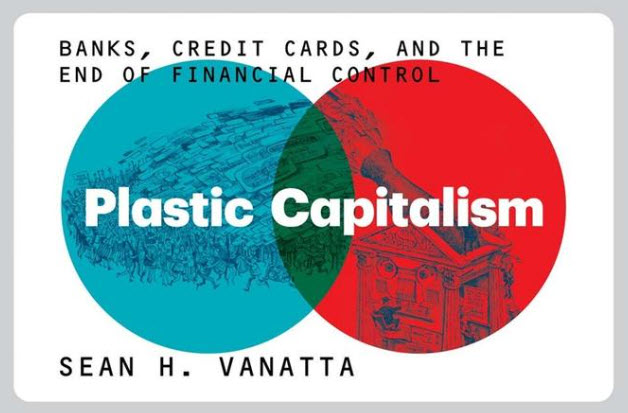
Sean Vanatta’s 2024 book Plastic Capitalism shows you what to look for.
First the big department stores started offering credit to their best customers. They gave them a special token so the clerks would know who could pay at the end of the month. The smaller retailers, with their smaller balance sheets and tighter margins, could not compete and so banks stepped in to offer the same kind of privileges for local merchants and their best customers. But not all communities were large enough to have banks that could do this. Worse, many of the larger urban banks were seeing their wealthiest customers move to the suburbs beyond their reach. The challenge was to connect large and small banks together to reach merchants and customers where they live, work, and travel. Computers equipped with standardized accounting software provided the answer by creating an infrastructure that could support an ever-expanding network. All that remained was to replace the special token with a plastic card to tie the customers with the banks.
If only it were that easy. Sean Vanatta does a brilliant job telling the story of how disruptive, dangerous, and complicated it was to move from store credit in the 1950s to the Visa and Mastercard we have today. A simple summary could never do justice to the many layers of identity, values, regulation, technology, competition, risk, politics, and unintended consequences involved in bringing us from a world where most transactions were settled with cash or bank paper to the world of bits and bytes. What is most striking while reading the book is how much we take this new world for granted and yet how alien our financial lives are when compared to the past. Anyone hoping to imagine the impact of digital currencies or distributed ledger technologies should read this book as an illustration of just how transformative that kind of innovation can be – and just how quickly that transformation can be taken for granted. As someone who grew up alongside this world of plastic, I cannot recommend Vanatta’s book highly enough.
What is most striking about Vanatta’s argument, however, is not the story it tells about plastic, but what it tells about finance. The credit card is just an instrument for financial integration that bankers used to break free from a federal regulatory framework designed to limit concentration and to constrain the geography of finance. Fundamentally, it is a story about the restless and relentless evolution in what it means to be a bank. That story starts with bricks and mortar in local communities and ends with the introduction of the first automated teller machines.
The origins story is the important part. Banks in the United States – whether national or state-chartered – existed to serve local communities. Only some states allowed banks to have multiple branches; no banks existed in multiple states. This fragmentation created important relationships of trust, but also important vulnerabilities. Banks and their customers had to be conservative because any disaster – drought, disease, new technology – could wipeout an entire community. Avoiding such disasters was the measure of a wonderful life.
Changing that mindset required a revolution in thinking about finance to make it less personal, less local, less communal, and less conservative. Every level of society was implicated, for good and bad. Vanatta is careful to underscore that the benefits of ‘financial citizenship’ were always reserved for the already privileged. Any attempt to change the order of power in society only invited backlash from those who feared losing what they had. The trick was to convince those conservative elements to embrace a new way of thinking. Vanatta identifies that shift as a pivot from an exclusionary paternalism where only some people are worthy of having access to credit – because that is what ‘creditworthiness’ is – to a more inclusive sense of market competition, where variable pricing can account for different levels of risk. The results may not be more egalitarian, but they were transformative. Almost nothing that touches the financial economy is the same.
Plastic Capitalism: Banks, Credit Cards, and the End of Financial Control. By Sean H. Vanatta. New Haven: Yale University Press, 2024.
***
This review is one of five that was published in the October/November (2025) issue of Survival. You can read the whole set here.
 Erik Jones
[…] You Think You Know Financial Disruption? […]
LikeLike